
QuinTron in SPACE
Share
How QuinTron Assisted the MARROW Project on the International Space Station
A few years ago, the University of Ottawa and the Canadian Space Agency approached QuinTron to assist with Project MARROW—a multi-year-long study that needed our breath-collection expertise.
The MARROW (Bone Marrow Adipose Reaction: Red or White?) study explored the effects of microgravity and space travel on human bones. The assumption was that microgravity negatively affects the bone marrow and blood cells. The MARROW project tested samples from the astronauts and measured the impact of their time in space.
The study’s research was conducted on the International Space Station and required precision engineering and planning. QuinTron was ready for the mission.
How QuinTron’s Involvement Began
The University of Ottawa and the Canadian Space Agency decided to reach out to our team after thoroughly exploring our cutting-edge system for collecting breath samples. While we usually work in the medical field, we have experience and overlap in the Aerospace industry, and the MARROW project presented an exciting opportunity for our team.
The MARROW researchers were looking for a system for breath sample collection and shared very detailed specifications and requirements. Space travel requires extreme attention to safety, ensuring that every product that an astronaut uses aboard the ISS is completely ready for microgravity and flight.
Throughout the design and engineering process, our staff was in constant communication with the MARROW project team to ensure each detail was perfect. Although QuinTron’s breath analysis products’ reliability is legendary here on Earth, we had to ensure they would deliver unfailing results in conditions beyond the planet’s atmosphere as well.
Our Simple Design was the Secret
Unsurprisingly, all products used aboard the ISS must be simple and straightforward. Since astronauts will use the products in zero-gravity, each item must be simple, easy-to-use, and involve as few steps as possible.
In microgravity and zero-gravity, something as seemingly benign as a wayward container cap can become a hazard. When working with samples, like liquids and gas, each collection must be precise and secure. Our QuinTron design team worked hard to minimize the steps and actions required for breath collection, keeping the product as barebones and straightforward as possible while retaining the highest level of accuracy for the collection techniques. Simplicity was our secret.
Our designers modified our breath collection product to meet all of the needs aboard the ISS. Each micro change required careful adjustments and multiple approvals from the various agencies for each change.
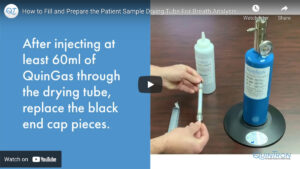
We collaborated with the NASA and Canadian Space Agency teams to ensure training materials, including videos were straightforward and easy to understand. Below, you can see the two training videos created for the project.
The MARROW project team’s biggest concern was safety, and of course, QuinTron met their needs hands-down. Beyond that, we focused on minimizing sample loss. When collecting air samples, especially in a zero-gravity environment, they must stay secure for a prolonged period. The samples must withstand changes in the atmosphere during reentry and the stringent conditions in space.
All testing pieces had to remain securely fastened throughout the collection process so they wouldn’t float around the Astronauts’ compartment. Astronauts frequently use Velcro to keep things in place, and the teams found ingenious ways to keep the testing pieces from floating away during the process using Velcro.
The samples also needed to be securely transferred from collection bags to a storage container. We had to design a method to ensure the transfer process would go smoothly and maintain the samples’ integrity. What is easy to do here on Earth can be a challenge in space!
Throughout the five-year study, the Space Agency collected hundreds of air samples and, based on the results, will likely conduct more studies beyond the five-year mark.
Stepping Up to the Challenge
Our design and build process took several months to be created, presented, and then to gain approval from the appropriate authorities. The QuinTron team worked with a research coordinator at the bone and joint research laboratory in Ottawa to make this process work smoothly.
QuinTron has worked across many industries, including aerospace, so we were familiar with some modifications required for our products to operate in the absence of gravity. We needed to account for atmospheric pressure and engineer a unique product that could meet all the study’s requirements.
When our product was complete, it was sent to engineers at the Canadian Space Agency, who went to NASA to finalize approval. About a month later, we received a positive response, and all systems were go!
The MARROW team commented, “We really like your product. It’s user-friendly and works well for us. We sent samples to our engineers, and it works for them as well.” QuinTron was honored to be a part of such an exciting endeavor.
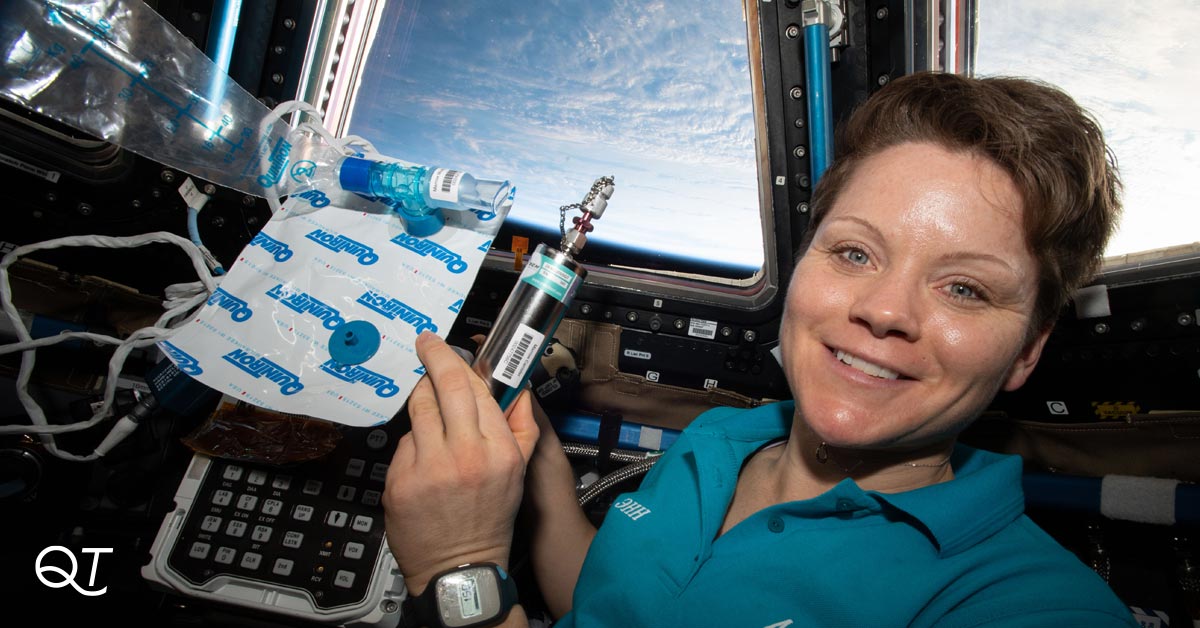
We received a surprise Twitter communication from astronaut Paolo Nespoli, who was using our product aboard the ISS to add to our accolades. NASA also shared details on the MARROW project in their newsletter, with an article and photo showing NASA astronaut Anne McClain holding up a QuinTron breath collector.
With the positive press and excellent results, QuinTron was proud to be a part of this project to help researchers gain insight into the effects of space travel. The experience was a fascinating way to stretch our knowledge and ensure our products are the best on the planet (and beyond).

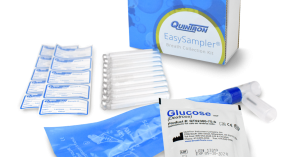
At Home Breath Test Kit
$249.00
Share
Latest Articles

When Online Support Groups Start Sounding Like Medical Advice

Breath Testing and Suspected SIBO: Why Interpretation Requires Clinical Context

When More Data Complicates Care: Rethinking Breath Testing in Modern GI Practice
Interpreting Hydrogen and Methane Breath Tests in Patients Using GLP-1 Therapies
Looking for Reliable SIBO/IMO Breath Testing?

SIBO and IMO: Understanding the Differences and Similarities